


Choosing and sizing
How to measure for a custom-size or recessed-well mat
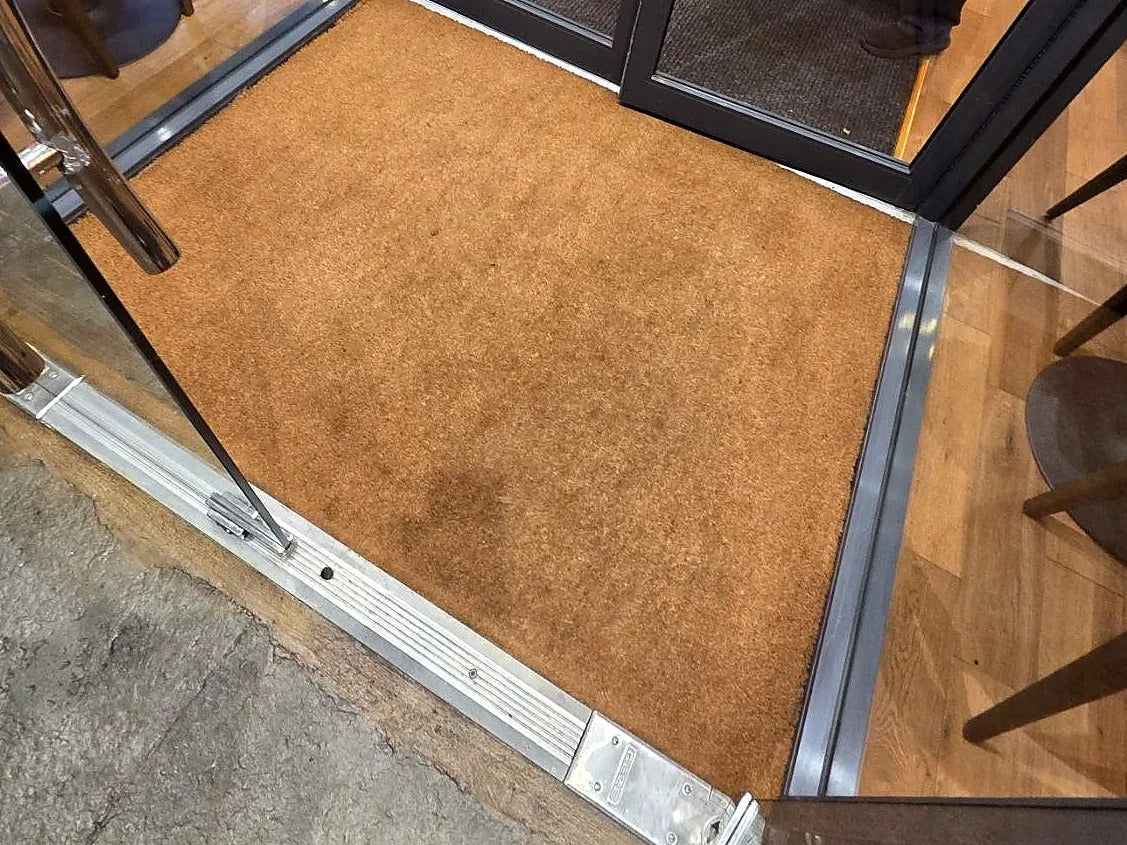
Most doormats are bought too small. Half of every step lands on bare floor and the mat cleans half a shoe. Measuring takes two minutes and a tape. This guide covers a mat that lies on the floor, a mat that drops into a recessed well, and a runner, and how each measurement goes into the custom-cut builder.
The rule: cover the walking path
A mat works only where feet land. Make it at least as wide as the door opening, and a few inches wider each side if there is room, because people step through anywhere across the door. For depth, 18″ catches one full step and 30″ or more catches two. Two steps clean a shoe far better than one.
How the builder names the sides
- Length runs side to side, along the door. It can be anything from 12″ to 44 ft in one piece (33 ft in 1¼″).
- Width runs out from the door, the way you walk. It can be 12″ to 6 ft, the width of the roll we cut from.
Sizes go in half-inch steps, in inches or in feet and inches. A mat for a 36″ door, 24″ deep, is 36″ long and 24″ wide.
A mat on the floor
- Measure the door opening inside the frame, not across the trim. Most American front doors are 36″; older houses and side doors are often 30″ or 32″. This is the least the length should be.
- Measure the depth you have: from the door, or from the arc it sweeps if it opens outward, to the edge of the step or landing. Keep the mat back from the edge of a step so it cannot hang over.
- Measure the gap under the door if it swings over the mat. The mat needs about ¼″ more than its own thickness: ¾″ of gap for a ½″ mat, ⅞″ for ⅝″, 1″ for ¾″, 1¼″ for 1″ and 1½″ for 1¼″.
For double doors, or a door with sidelights, size the mat to the whole opening, not the door leaf. One mat across a 72″ opening has no seam to catch a toe; two mats side by side drift apart.
A recessed mat well
A mat well is a recess built into the floor to hold a mat flush with it. A well is unforgiving: a mat cut small slides and leaves a gap to trip on, and one cut large buckles.
- Measure the inside of the well both ways, at each end. Wells are rarely square. Take the smaller of each pair.
- Take ¼″ off each way and enter that size. A well 96″ by 54″ takes a mat 95¾″ by 53¾″, so in half-inch steps, 95½″ by 53½″. The mat drops in and lies flat.
- Measure the depth of the well and choose the thickness that matches it, so the mat sits flush: ½″, ⅝″, ¾″, 1″ or 1¼″.
Sending sizes for a quote instead? Give us the opening as you measured it, and we take off the ¼″.
A runner
For a covered porch, a breezeway, a mudroom or a long hall, one long piece beats a row of small mats: no seams, no gaps, nothing to drift. Match the width to the walkway (24″ to 36″ covers most) and the length to the covered path, up to 44 ft in one piece.
What it costs
Custom cuts are priced by the square foot, by thickness:
| Thickness | Per square foot |
|---|---|
| ½″ | $10 |
| ⅝″ | $11 |
| ¾″ | $12 |
| 1″ | $13 |
| 1¼″ | $14 |
Natural comes in every thickness. Chocolate and Black come in ⅝″, for $1 more per square foot. A 36″ × 24″ mat at ½″ is 6 square feet, so $60.00; a 72″ × 30″ double-door mat at ½″ is 15 square feet, so $150.00. The builder shows the price as you type.
Before you order
Measure twice. Every custom cut is made for you, so it can be returned within 30 days with a 15% restocking fee. Custom cuts ship the next business day, the same as our stock mats, and shipping is calculated by size and ZIP.
Once it is down, Caring for a coir mat covers keeping it working for years.